

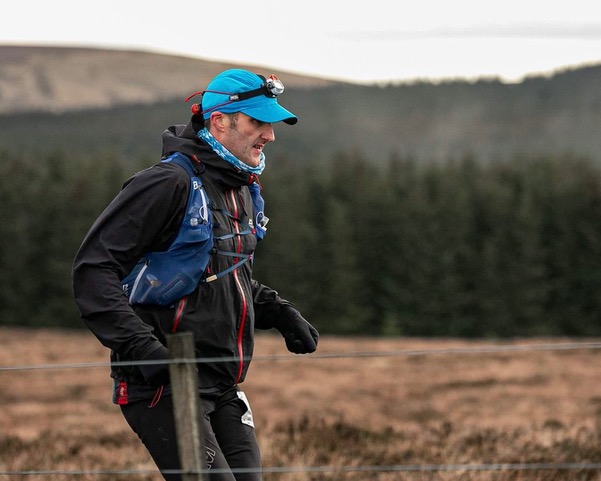
Name: Ian Leach
Occupation: Police Officer
Home Town: Gateshead
Questions
What is your running background?
I was into martial arts in the early-90’s and started running for aerobic conditioning. I entered a few local road races and ran my first half and full marathon, but I wasn’t training seriously. I joined a circuit training club run by an ex-Royal Marines Commando and PTI, Clive Gibson. Clive encouraged us to enter events as a team, including the Chevy Chase, a 20 mile fell run in Northumberland. That got me hooked on racing and long distance, off-road events.
When did you first start running Ultra marathons and why?
My first ultra was the Fellsman in 2005, a 60 mile race over rough, hilly terrain. I probably read about it in Runner’s World magazine and thought ‘How hard can it be?’. The answer is ‘really quite hard’. I had no clue what I was doing and finished with very blistered feet and 12 uneaten banana muffins in a backpack I’d borrowed from my mother-in-law. I only got round because of the navigational wizardry of the runners I was grouped with for the night section. If it wasn’t for them, I think I’d still be up there.
When or where (at which events) are we most likely to see you?
I don’t race very often, but you’ll occasionally see me at Hardmoors events, Lake District ultras or local trail races (and maybe the odd road race). I’m almost always training for something, whether it be a running or cycling event.
What are your personal key running achievements to date?
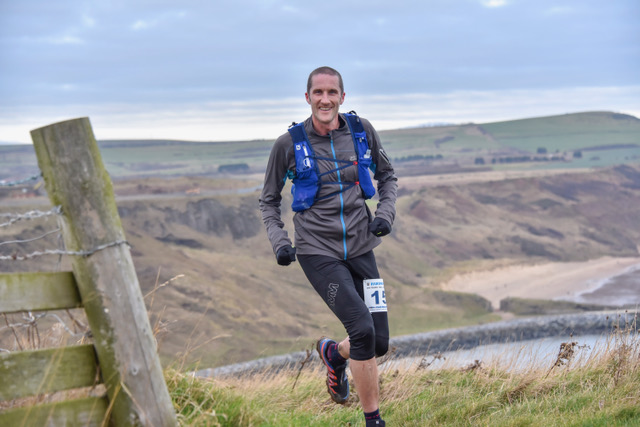
Being the highest placed Briton in the 2007 Marathon des Sables. Finishing the 2011 Ultra Trail du Mont Blanc when over half the field DNF’d. More recently, becoming a member of the Bob Graham 24 Hour club, and being one of only five finishers in the 2022 Viking Way ultra (which was utterly grim).
What was your hardest experience?
Hardmoors 160, 2014. A foolish shoe choice meant I shredded my feet so the last 40 miles were like running on broken glass.
What is your typical race strategy for an ultra?
I try to control as much as I can. I recce the route if possible, or otherwise study the course using maps, street view, videos from YouTube etc… I don’t hang around at checkpoints and try to do everything on the move, even if it’s just a slow walk. I try not to get drawn into running faster or slower than I want to and just aim to run at a natural pace that feels sustainable.
What does a typical training week look like?
I don’t really have one. If I don’t have an event planned, I tend to just tick over. I’m as much of a road cyclist as I am a runner, so I’ll cross-train between the two. If I’m training for an event, I’ll aim for specificity and try to mimic the terrain and conditions as much as possible. Hilly, off-road events will see me doing lower volume but lots of climbing and descending on rough terrain, and vice versa.
What one tip would you pass onto people running an Ultra marathon for the first time?
You need to train your mind as much as you do your body. Run when you don’t feel like it; run when it’s cold, wet, windy or scorching hot; run when you’re tired and fed up and when running is the last thing you want to do. At some point in the race, that’s how you’re going to feel, and you need to know what to do.
Tell us one interesting fact about you?
I have a research degree and my work has been published in a peer-reviewed academic journal.

Have you taken part in the Spartathlon before?
No
How did you get on?
N/A
What tip would you pass on to those taking part for the first time?
N/A
What are you looking forward to at the Spartathlon race?
You can’t replicate the atmosphere of large-scale events. I love the camaraderie among runners and how the people from towns and villages along the route come out in support.
What are you not looking forward to during the Spartathlon race?
Chasing cut-offs. They add an extra layer of anxiety (and jeopardy) which I could really do without.
How will you prepare specifically for the Spartathlon race?
I’m running on roads and less-technical trails more than I would do normally because I need to get used to the regular pacing. I’ve already started the obsessive planning.
Will you be bringing any support crew to the race? (If so, please introduce them briefly)
No. My family were keen to come along, but I’m going this alone.





 British Spartathlon Team