

Name: Matthew Ma
Occupation: Principal Engineer
Home Town: Milton Keynes
Questions
What is your running background?
I did some sprinting in Track and Field back in school but never did any formal training, and stopped when I went to college and University. I didn’t really pick it up until my mid-twenties when I got roped into a Mud Run race (I guess the precursor to what is now commonly known as Tough Mudder). It kind of went from there and I’ve not stopped running since early 2010s.
When did you first start running Ultra marathons and why?
I read “Born to Run” by Chris McDougall (I mean, who hasn’t read/heard of it if you are into Ultra marathons) and that’s when I came across the Legend that is Scott Jurek. It didn’t take long after I read Scott Jurek’s memoir “Eat & Run” before I entered my first Evesham Ultra (~47miles) in 2013.
How I run and eat to this date is, by and large, heavily influenced by Scott Jurek’s past and achievements. His memoir also introduced me to Spartathlon, which it felt so out of reach back then!
When or where (at which events) are we most likely to see you?
I am a fairly stingy and low-key person so I tend to avoid popular events which usually attract a high price tag. I used to go by the rule of £1 per mile so not surprisingly I spent a lot of my early days doing LDWA events.
A couple years ago I discovered the Canal Races so in preparation for those I’ve spent most of my time running on roads and canals, this was especially useful when I live <1 mile away from the Grand Union Canal! I do miss mountain trails so will look to spending more time away from the canals next year.
What are your personal key running achievements to date?
I struggled to complete a 100 miles Ultra for many years, I must have tried half dozen times in the late 2010s but I had always DNF’ed about 2/3 of the way, I know physically I was capable but mentally something is stopping me from going further.
In the 2010s the furthest I had ever completed was 86 miles (Ridgeway Challenge) starting in 2016, gradually got a little quicker every year and finishing 1 st with my best time of 15:05 in 2019. I put it down to mostly luck as it was a ridiculously hot and humid day which a lot of people struggled, but I managed ok so long as I had enough water.
Not being able to complete a 100 miles Ultra had been a thorn in my side. During Covid lockdown I spent a lot of time thinking (and occasionally running) and tweaked my mindset on how to approach late race fatigue.
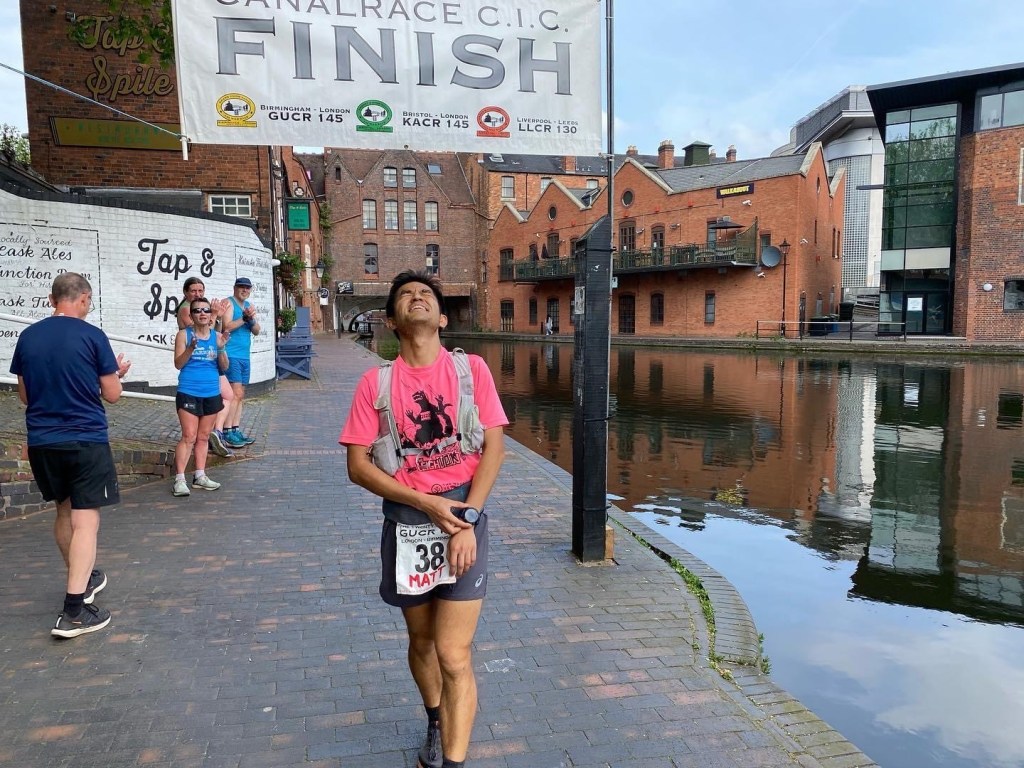
What’s better way to put that to test but the Grand Union Canal Race (GUCR 145) in 2023!
I struggled with sleep the night before as I stayed at a hostel, but on race day I stuck to my plan and, again with a lot of beginner’s luck, slowly grinded my way from middle of the pack at the start to finishing 1st with a time of 27:52.
What was your hardest experience?
I am no stranger to DNF (I seem to have my favourite photos taken when I DNF), but Liverpool to Leeds Canal Race (LLCR 130) 2023 was, by far, my hardest race experience. Not because the course was hard (it really wasn’t), but because I got so close in getting the Canalslam 2023 but only to DNF with less than 30 miles left, due to my lack of preparation (got too cold during the night) and the cumulative fatigue and injuries from previous Canal races that year.
Looking back, I was a bit ambitious to complete the Canalslam on my first try, so I returned this year and finished what I started, completing the ‘slam 2024.
What is your typical race strategy for an ultra?
I discovered I can overcome that mental block by focusing on the now, rather than the finish. Simple.
But I need some structure, so I break down the race in 5 miles lap. No matter how tired I become, I am only focusing on getting to mile 5 when I “reward” myself with food and drinks, this can typically take from 45min to 1hr15min as my pace drops. After each 5 miles lap, I also “allowed” myself to slow down, up to 30s per mile, for the next lap if I need to. Realistically I AM slowing down, but being able to consciously “allowing” myself to
slow down really helps dealing with the mental fatigue in latter part of an Ultra.
I guess as I get more experience with 100+ miles / 24+ hours race I’ll be more confident with pushing harder like I do in shorter Ultras. I know this approach does not give me the fastest time, but I am more likely to complete the race by taking it slow, and slower.
What does a typical training week look like?
The mileage, pace, and surfaces that I run on depend on what races that I am training for. But regardless I adopt a 4 weeks training cycle, where I progressively increase my distance / intensity over week 1-3, then an easy / recovery week 4. Those are the basic building blocks of my training/maintenance cycle.
What one tip would you pass onto people running an Ultra marathon for the first time?
When it gets tough in latter part of an Ultra marathon, just remember, it’ll get “better”. At some point it will stop getting harder and just stays hard, but you are used to that now.
Tell us one interesting fact about you?
I had a larger-than-life size banner of myself (think conference display stand size) for 10+ years.
Have you taken part in the Spartathlon before?
No
How did you get on at Spartathlon?
N/A
What tip would you pass on to those taking part for the first time?
N/A
What are you looking forward to at the Spartathlon race?
Mentally, I am looking forward to running 5 miles lap, 30 times, then finish the Spartathlon with a 5k.
Physically, being on the start line with some of the greatest Ultra runners and, fingers crossed, being able to finish a race that I first read about over a decade ago, a race that felt impossible at the time, I would be more than ecstatic.
What are you not looking forward to during the Spartathlon race?
Pain. I can deal with general muscle pain, fatigues, soreness and aches, but anything from external like chaffing and blisters will just drain me.
How will you prepare specifically for the Spartathlon race?
Just before Christmas last year I rolled my ankle badly during my local Park Run, an injury that stopped me from running for the first time in a decade. I’ve spent first half of this year on strength training and building up that flexibility again, and slowly eased into a few runs and races that I had already entered.
Not perfect, but I’d say 90% there now for Spartathlon.
While I was recovering, I focused on optimising everything else apart from running such as nutrition and fuelling, gears, and generally being more efficient. I’ve been reading other people’s Spartathlon experience too, in particular the book “Running Up That Hill” by Vassos Alexander. Hopefully I won’t end up in a wheelchair at the airport like him after the Spartathlon!
Will you be bringing any support crew to the race? (If so, please introduce them briefly)
I normally fly solo so this is no different. My partner was initially planning to meet me after the race and spend some time together in Greece, but she’ll be 32 weeks pregnant so I ought to fly back soon after the race and fingers crossed she won’t be early!





 British Spartathlon Team