Name: Paula Bedford
Occupation: Running Coach, Race Director & Business Analyst
Home Town: London
Socials: @onehandedrunner
Questions
What is your running background?
I first discovered running through athletics at school when I was around 13 or 14. It gave me something positive to focus on and kept me out of a bit of trouble. When I left school I stopped running altogether and didn’t return to it until after my first son was born in 2007, when I started doing standard-distance triathlons.
After my second son was born in 2013, I gradually realised that running was the part I loved most. I began focusing purely on running, and before long that led me into the world of ultramarathons, where I found I really felt at home.
When did you first start running Ultra marathons and why?
I started running ultras a couple of years after my second son was born. My original goal was actually to run the London Marathon in 2017, and I decided the quickest way to get there was to achieve a Good for Age qualifying time, which I managed to do.
During marathon training I discovered something unexpected. Those long runs gave me precious time to myself, out in nature, away from the demands of work and family life. I realised I loved this! I started to hear about these crazy Ultrarunning events and thought I’d give it a try… it gave me exactly what I was looking for: more time outdoors, more adventure, and more opportunities to discover what I was capable of.
When or where (at which events) are we most likely to see you?
You’ll most likely find me handing out hugs and snacks at Camino Ultra events or the London 100. I don’t get to race as often as I’d like because of work and family commitments, so I tend to choose events carefully.
I particularly love Centurion races—they’re exceptionally well organised, the volunteers are incredible, and the atmosphere is always welcoming. I’ve completed the 50 Slam, Thames Path 100 and Winter Downs 100 with them.
I also have a real soft spot for winter racing, especially the Spine events. There’s something special about running through the night that I absolutely love.
What are your personal key running achievements to date?
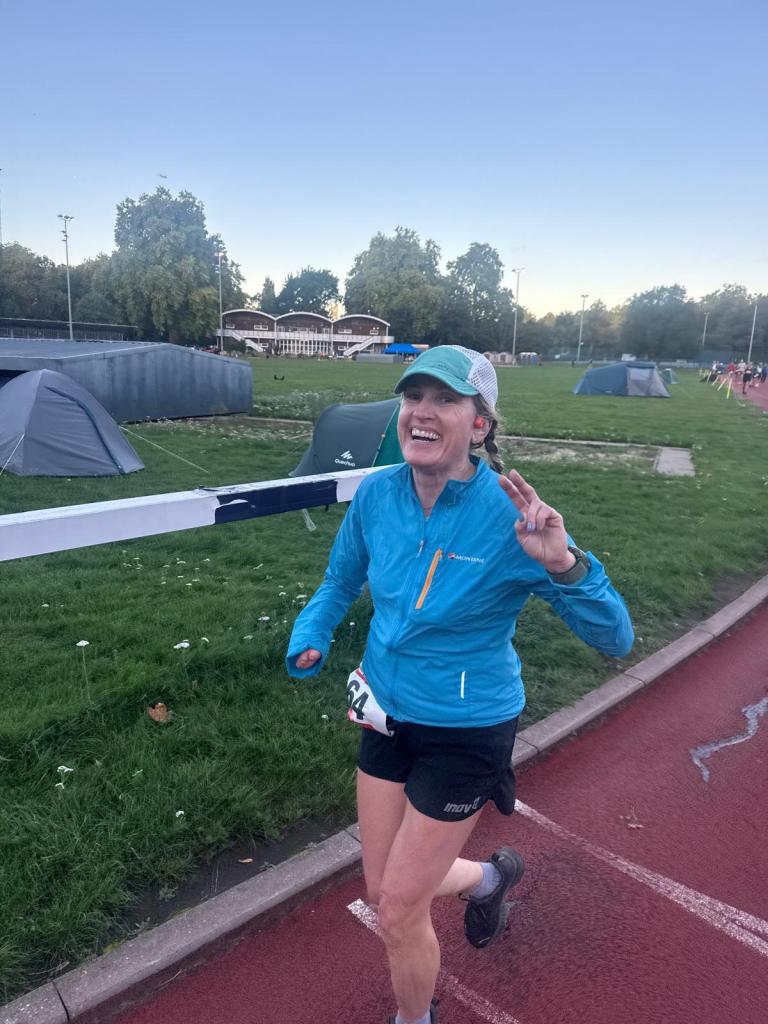
Winning the women’s race and finishing in the overall top ten at the Sri Chinmoy 24-Hour Race last year is definitely my proudest achievement. At the start of the race I genuinely didn’t believe winning was possible, but as the hours passed I realised I had a chance. With the support of my coach the one and only David Bone and all the wonderful Camino family that came down to the track, I kept believing and managed to achieve something I never imagined possible at 52. I got a 100 mile pb and that meant i could enter the Spartathon lottery, and here I am!
I’m also proud to have finished on the podium at the Winter Downs 100 in 2024. I enjoy winter races—they’re tough, but I love running through the night and the unique challenges they bring.
Another memorable achievement was finishing the Winter Spine Challenger South in 2025. The Spine races are unlike anything else and hold a special place in my heart.
What Races do you have planned up to Spartathlon
I don’t actually have any races planned before Spartathlon. As one of the organisers of the London 100, I’ve somehow never covered the entire route in one go, so my plan is to run a self-supported solo version of the course sometime over the summer. It feels like the perfect way to spend a long day out before heading to Greece.
What is your typical race strategy for an ultra?
Having read a lot of these profiles, it seems most people say they go off too fast. That’s definitely not my problem!
I’m very much a slow, steady and consistent runner. I like to settle into a sustainable rhythm from the start, enjoy the first half of the race and leave enough in the tank so I’m not completely falling apart at the end.
Spartathlon is going to push me well outside my comfort zone because the early cut-offs demand a completely different approach. It’ll be interesting to see if I can change my habits to get through Spartathlon.
What does a typical training week look like?
Most of my training is made up of very easy runs around my local area, almost always at a conversational pace and often nose breathing. I fit my running around work, family life and coaching, so consistency is much more important to me than chasing huge mileage.
Alongside my running, a big part of my training is my Feldenkrais practice. I’m currently training to become a Feldenkrais practitioner, and the awareness, movement efficiency and recovery it brings have become an important part of my training toolbox. I believe it helps me move more freely, recover better and keep enjoying running as I get older.
I make sure I include regular long runs, but overall my philosophy is that easy running, thoughtful movement and consistency are what keep me healthy and enjoying the sport.
What one tip would you pass onto people running an Ultra marathon for the first time?
For me, ultrarunning has always been about adventure. Choose a race that genuinely excites you and takes you somewhere you want to explore, whether that’s close to home or somewhere completely new.
Most importantly, don’t be afraid to try something that feels just beyond what you think you’re capable of. From my own experience, some of the things I’ve been most proud of are the ones I never believed I could achieve.
Tell us one interesting fact about you?
I was born without my right hand. It has never been something I’ve seen as holding me back—it has simply taught me that there’s always another way of doing things. That mindset has shaped my approach to running, coaching and life.

Have you taken part in the Spartathlon before?
No—this will be my first Spartathlon.
How did you get on?
N/A
What tip would you pass on to those taking part for the first time?
N/A
What are you looking forward to at the Spartathlon race?
I’m really looking forward to soaking up the atmosphere of such an iconic race. I’ve heard so many incredible stories from friends who’ve completed Spartathlon that it already feels like a very special event before I’ve even stood on the start line.
I’ve spent a lot of time imagining what it’ll feel like to reach Sparta and kiss King Leonidas’ foot. And, if all goes to plan, I’ll also be looking forward to lying on a beautiful Greek beach afterwards!
What are you not looking forward to during the Spartathlon race?
Without doubt, the early cut-off times. They don’t really suit my style of racing, so I’ll need to step outside my comfort zone from the very beginning.
But that’s one of the reasons I wanted to take on Spartathlon. If I want to earn that finish, I’ll simply have to embrace the challenge.

How will you prepare specifically for the Spartathlon race?
The focus will be on staying consistent with my easy running while putting extra emphasis on my long runs, nutrition and heat training.
I’d also like to gradually build my mileage over the summer and, more importantly, maintain it consistently. Spartathlon is a race that rewards patience and preparation, so that’s exactly what I’ll be aiming for.
Will you be bringing any support crew to the race? (If so, please introduce them briefly)
I feel incredibly lucky with my crew. My coach and ultra legend David Bone, will be looking after me, and also Darren Strachan will be there as part of the team.
No pressure then!